Freelance Income Calculator: How to Calculate Your Real Take-Home Pay
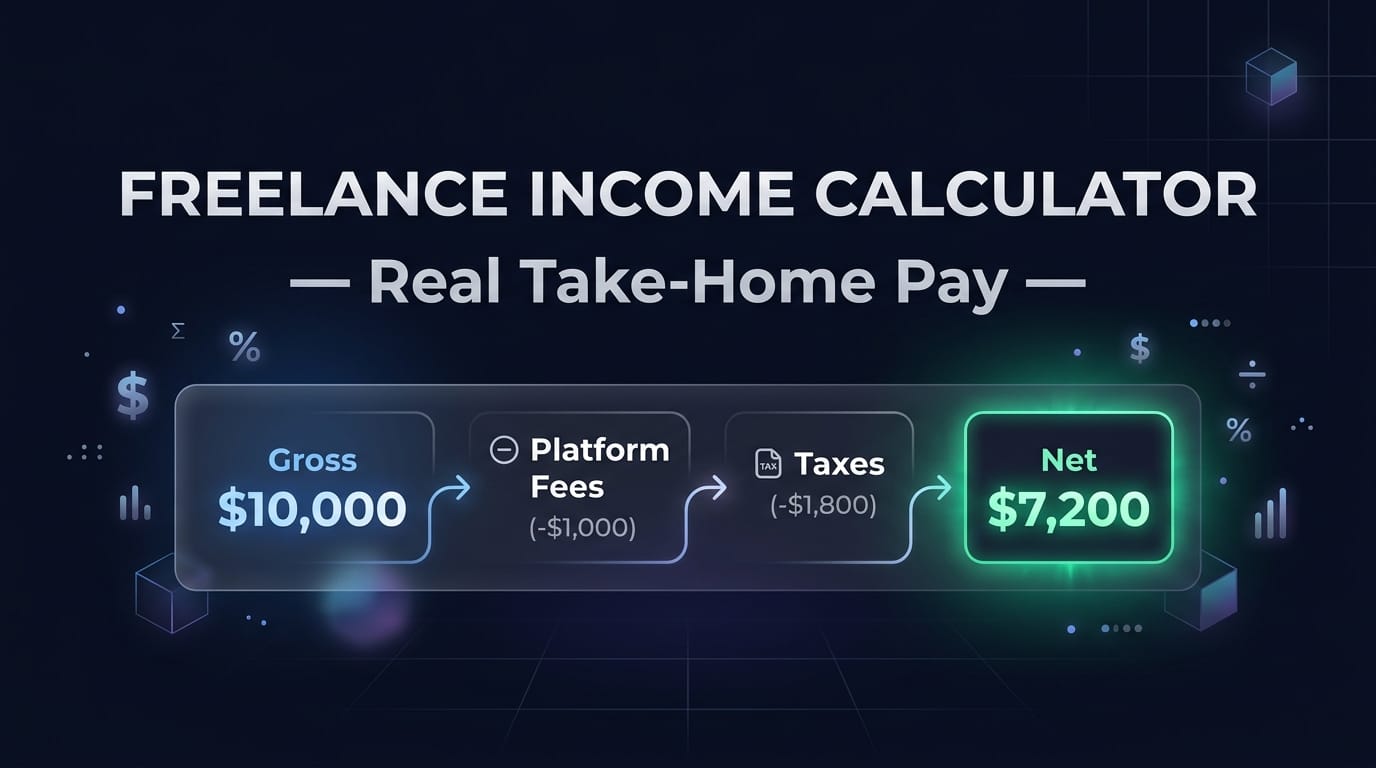
Real freelance take-home = Gross Revenue − Platform Fees − Business Expenses − Self-Employment Tax − Income Tax
For US freelancers: expect to keep 55–65% of your gross income after SE tax (15.3%) and income tax
Platform fees: Fiverr 20%, Upwork 10%, direct billing ~3%
Use the Net Income Calculator to model your exact take-home
Every freelancer has experienced the shock of invoicing $10,000 in a month and somehow ending up with $5,800 in their bank account at year-end. The gap between your gross revenue and your actual take-home pay is wide, predictable, and entirely calculable — once you know the formula.
The Freelance Income Formula
Your real take-home pay follows this sequence:
- Gross Revenue — Total money invoiced and received from clients
- Subtract Platform Fees (if using marketplaces like Upwork or Fiverr)
- Subtract Business Expenses (software, equipment, professional services, etc.)
- = Net Profit (Taxable Income)
- Subtract Self-Employment Tax (US: 15.3% of net; UK: Class 4 NI; EU: varies)
- Subtract Income Tax (based on your tax bracket after allowable deductions)
- = Real Take-Home Pay
US Freelancer Example: $10,000/month Gross Revenue
Let’s build a full breakdown for a US-based freelance developer working through Upwork and direct clients:
| Item | Monthly | Annual |
|---|---|---|
| Gross Revenue | $10,000 | $120,000 |
| Platform fees (Upwork 10% on $5k; direct 3% on $5k) | −$650 | −$7,800 |
| Business expenses (software, accountant, equipment) | −$800 | −$9,600 |
| Net Profit (Taxable) | $8,550 | $102,600 |
| Self-employment tax (15.3%, SE deduction applied) | −$1,255 | −$15,060 |
| Federal income tax (22% bracket, QBI deduction applied) | −$1,610 | −$19,320 |
| Real Take-Home Pay | $5,685 | $68,220 |
This freelancer invoices $120,000/year but takes home $68,220 — a 43% reduction. If they only tracked gross revenue, they’d be dramatically overestimating their actual income.
UK Freelancer Example: £8,000/month Gross Revenue
A UK-based sole trader (not limited company) earning £8,000/month:
- Annual gross: £96,000
- Business expenses: £9,600
- Net profit: £86,400
- Class 4 NI (9% on profit £12,570–£50,270; 2% above): ~£6,152
- Income Tax (20% basic rate on £37,700; 40% on the rest after personal allowance): ~£26,040
- Real take-home: ~£54,208 (56% of gross)
The Hidden Costs Most Freelancers Miss
Beyond taxes, there are costs that reduce your effective income but don’t appear on tax returns:
- Health insurance (US): $400–$700/month if self-funded — not tax-deductible until you hit the 7.5% medical expense threshold
- Retirement contributions: Money put into a SEP-IRA or Solo 401(k) is technically still yours — but it locks up cash flow
- Non-billable time: Every hour spent on proposals, emails, and admin is revenue you didn’t earn. If you spend 30% of your work time on non-billable tasks, your effective hourly rate is 30% lower than it appears
- Late payments and bad debt: Industry average: 1–3% of invoiced revenue is never collected
How to Calculate Your True Hourly Rate
Your true hourly rate isn’t your invoice rate. It’s:
True Hourly Rate = Annual Take-Home Pay ÷ Total Hours Worked (including non-billable)
If you take home $68,220 and worked 2,200 total hours (including admin), your true hourly rate is $31/hour — even if your invoice rate is $100/hour. This isn’t discouraging — it’s empowering. It shows exactly how much to charge to hit your income goal.
Use the Net Income Calculator and Hourly Rate Calculator at FreelancerCalculator.com to model your exact numbers across different income levels, expense scenarios, and tax situations.
Ready to optimize your freelance finances?
Calculate your rates, taxes, retainer values, project profitability, and more with our interactive tools designed specifically for independent professionals.