Freelance Pricing Calculator: How to Price Your Services in 2026
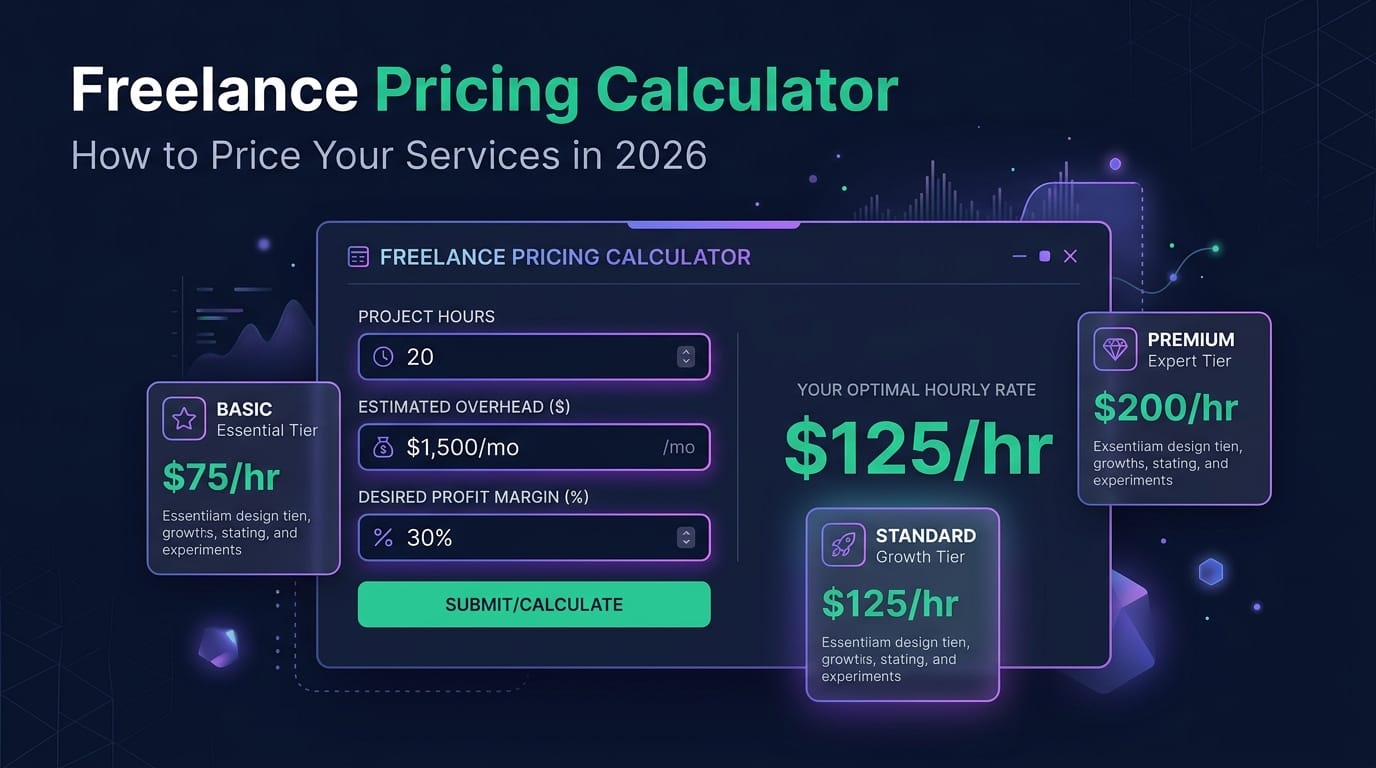
Three pricing methods: Cost-Plus (floor price), Market Rate (competitive price), Value-Based (ceiling price)
Cost-Plus formula: (Annual Income Target + Expenses) ÷ Billable Hours ÷ (1 − Profit Margin)
Always calculate your cost-plus floor first — never price below it regardless of market rates
Use the free Freelancer Pricing Calculator at FreelancerCalculator.com — no download needed
People search for a “freelance pricing calculator download” because they assume pricing is complicated enough to require special software. It’s not. The formula is straightforward, and once you understand it, you’ll be able to calculate a defensible rate in under 5 minutes without downloading anything.
The Three-Layer Pricing Model
Strong freelance pricing is built from three layers, each answering a different question:
- Cost-Plus Pricing → “What do I need to charge to survive?” (Your floor)
- Market Rate Pricing → “What do comparable freelancers charge?” (Your anchor)
- Value-Based Pricing → “What is the outcome worth to the client?” (Your ceiling)
The smartest freelancers use all three: cost-plus gives them a floor they never go below, market rates give them competitive context, and value-based thinking allows them to charge premiums for high-ROI work.
Layer 1: Cost-Plus Pricing (Your Floor)
The cost-plus formula builds your rate from the inside out:
Hourly Rate = (Target Annual Income + Annual Expenses) ÷ Billable Hours ÷ (1 − Profit Margin %)
Step-by-Step Example
- Target take-home income: $80,000/year
- Annual business expenses: $8,000
- Estimated billable hours: 1,200/year (realistic for full-time freelancer)
- Desired profit margin: 20%
Rate = ($80,000 + $8,000) ÷ 1,200 ÷ 0.80 = $73.33 ÷ 0.80 = $91.67/hr
Round to $95/hr. This is your floor. You should never accept work below this rate — doing so means you literally cannot meet your income goals.
Layer 2: Market Rate Benchmarking
Once you know your floor, research market rates for your specific role and skill level:
| Role | Entry | Mid | Senior |
|---|---|---|---|
| Software Developer | $60–80 | $100–140 | $150–250+ |
| UX/UI Designer | $50–70 | $85–120 | $130–200+ |
| Copywriter | $40–60 | $75–110 | $120–180+ |
| Data Analyst | $55–75 | $90–130 | $140–220+ |
| Marketing Consultant | $45–65 | $80–120 | $125–200+ |
Layer 3: Value-Based Premium Pricing
Value-based pricing decouples your fee from your time and anchors it to the client’s gain. If your SEO work generates $500,000/year in new revenue for a client, charging $200/hour is a tiny fraction of the value delivered. The framework:
- Quantify the problem: what does this cost the client today?
- Estimate your solution’s impact: what’s the annual value of fixing it?
- Price at 10–20% of that annual value
The Value-Based Pricing Calculator at FreelancerCalculator.com helps you structure this conversation with clients mathematically — and defend higher rates with confidence.
Ready to optimize your freelance finances?
Calculate your rates, taxes, retainer values, project profitability, and more with our interactive tools designed specifically for independent professionals.