Freelance Taxes in the Balkans: Serbia vs Croatia vs Bosnia vs Slovenia (2026)
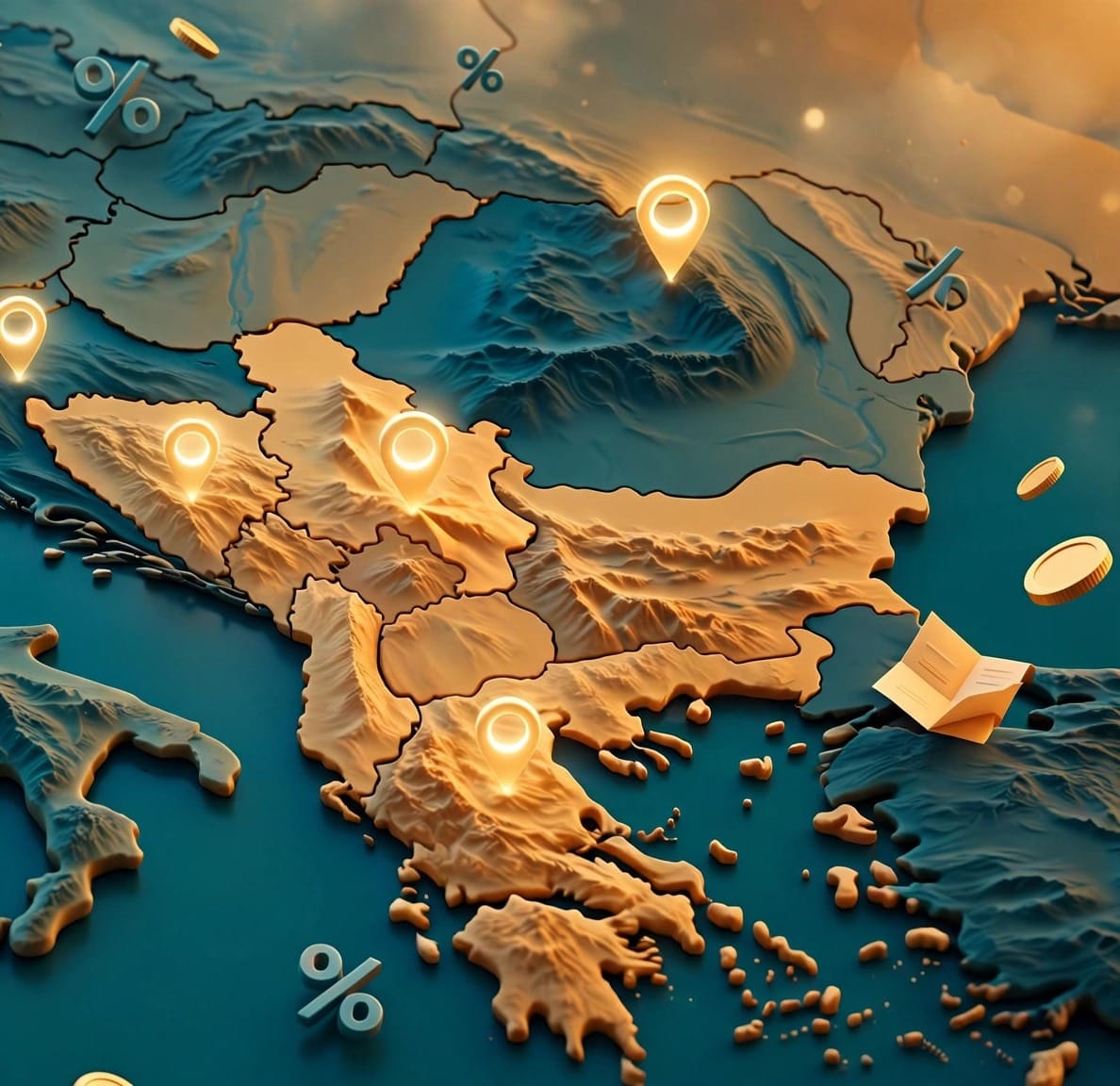
The Balkans have quietly become one of Europe’s most interesting regions for freelancers. Living costs sit well below Western Europe, the time zone overlaps neatly with EU clients, and several countries have built registration paths aimed directly at independent workers. But freelance taxes Balkans freelancers actually face are anything but uniform — each country runs its own system, and the differences matter more than the geography suggests.
This guide compares the four countries freelancers ask about most: Serbia, Croatia, Bosnia and Herzegovina, and Slovenia. You will get a side-by-side overview, a short section on each country’s common setup, and the digital nomad angle — all in plain language, without invented rates or false precision.
Tax rules change, and details always depend on your residency, income, and type of work. Treat this as a map, not the territory: as of 2026, verify anything involving real money with a local accountant. Our methodology page explains how we research regional tax content.
Why Freelancers Look at the Balkans
Remote work untethered location from income, and the Balkans offer a combination that is hard to beat: affordable rents, good internet, café cultures that run on laptops, and flight connections to the rest of Europe. Governments noticed — several countries have introduced or refined frameworks for the self-employed, and freelancing here is increasingly formalized. Formalized means predictable, and predictable means you can plan.
The catch is fragmentation. There is no single Balkan tax system. Four neighboring countries can mean four entirely different registrations, four sets of paperwork, and four philosophies about how independent work should be taxed. That is exactly what this comparison untangles.
The Four Countries at a Glance
Before the detail, here is the short version — the setup freelancers in each country most commonly use, and how complicated it tends to be:
- Serbia — Common setup: the paušalac (lump-sum taxation) model, or the Model A / Model B freelancer tax models. Complexity: moderate, and the best-documented in the region, with an active community sharing practical guidance.
- Croatia — Common setup: the paušalni obrt (flat-rate trade). Complexity: straightforward once registered; as an EU member, EU rules and standards apply.
- Bosnia and Herzegovina — Common setup: varies by entity. Complexity: the highest in this group. The Federation (FBiH) and Republika Srpska run separate tax administrations, and the effective burden is generally higher than in neighboring countries.
- Slovenia — Common setup: the s.p. (sole proprietor), with an optional normirani stroški (standardized expenses) regime. Complexity: moderate; the standardized-expenses option simplifies bookkeeping considerably.
For a sense of how we break down other regions in the same practical style, see our Pakistan freelancer tax guide.
Serbia: The Region’s Most Documented System
Serbia has the region’s most discussed freelancer tax framework: the paušalac lump-sum model, where eligible freelancers pay tax on an assessed lump sum rather than actual income, and the newer Model A / Model B freelancer tax models, which take different approaches to taxing freelance income.
Rather than re-explain it all here, we will point you to the deep coverage this site already carries. Our Serbia freelance tax calculator (Model A vs Model B, 2026) walks through both models side by side, and our Serbian freelancer lump-sum (paušalac) guide covers the flat-rate option in detail.
A few qualitative notes for the comparison. Serbia is not in the EU, which cuts both ways: fewer EU-wide obligations, but also fewer EU-wide simplifications. And because Serbia has the region’s largest English-speaking freelancer community, practical answers — which forms, which office, which accountant — are easier to find than anywhere else here. As of 2026, that community knowledge is a genuine asset.
Croatia: The Paušalni Obrt
Croatia’s answer for small independent workers is the paušalni obrt — a flat-rate trade registration. Instead of tracking every expense and calculating tax on actual profit, the freelancer pays tax and contributions at fixed, predetermined amounts. For freelancers with simple cost structures, that trade-off is attractive: less bookkeeping, more predictability.
The keyword in Croatia freelancer tax paušalni obrt discussions is always eligibility. Flat-rate regimes come with conditions — income ceilings, permitted activities, registration steps — and Croatia’s is no exception. The structure is simple once you are inside it; getting inside it correctly is where local guidance pays for itself.
As an EU member, Croatia brings the EU layer into the picture: VAT rules for cross-border services, standardized invoicing expectations, and administrative machinery your EU clients already understand. A Croatian invoice needs no explanation in Berlin or Amsterdam.
Croatia also offers a dedicated digital nomad residence permit (covered below) — but the permit and the tax setup are separate questions. A residence permit solves immigration, not taxation.
Bosnia and Herzegovina: Two Entities, Two Rulebooks
Bosnia and Herzegovina is the complicated one, and the complication is constitutional. Taxation differs between the two entities — the Federation of Bosnia and Herzegovina (FBiH) and Republika Srpska — each with its own tax administration, rules, and procedures. A freelancer in Sarajevo and a freelancer in Banja Luka effectively operate under different systems.
On the Bosnia freelancer tax rate question, the honest qualitative answer is: it depends on the entity, and the effective burden is generally higher than in Serbia or Croatia. The rules are also less standardized for freelancers specifically — less of the purpose-built freelancer framework you find in Serbia, which means more interpretation, more paperwork, and more reliance on professional advice.
That is not a reason to rule Bosnia out; living costs are among the lowest in this comparison. It is a reason to budget for an accountant from day one rather than figuring it out alone. In a two-administration system, expert guidance costs far less than getting it wrong. As of 2026, entity-level rules continue to evolve, so treat any specific figure you find online — including older forum posts — with suspicion until a local professional confirms it.
Slovenia: The S.P. With Normirani Stroški
Slovenia runs the most northern-European system of the four. Freelancers commonly register as an s.p. — samostojni podjetnik, a sole proprietor — a well-established business form with clear rules and full access to the EU market.
The interesting part is the normirani stroški option: standardized (or “normed”) expenses. Under this regime, instead of documenting actual business costs, deductible expenses are set at a fixed percentage of revenue. For freelancers with low real costs — writers, designers, developers, consultants working from a laptop — this is a meaningful simplification: less receipt-chasing, cleaner books, a tax base you can predict in advance.
The Slovenia s.p. normirani stroški freelancer discussion always comes back to the same trade-off as any flat-rate system: simplicity versus precision. High actual expenses? Deducting real costs may serve you better. Low expenses? The standardized route usually wins on both tax and sanity. Have that conversation with a Slovenian accountant before you register, not after.
One caveat: Slovenia is the priciest base here — EU living standards with costs to match. Orderly and predictable, but the budget math has to work.
Serbia vs Croatia: Which Fits a Freelancer Better?
This is the comparison freelancers actually agonize over, so let us address the Serbia vs Croatia freelancer tax question directly — qualitatively, since the right answer depends on the person.
Choose Serbia’s orbit if you value the deepest pool of freelancer-specific knowledge, lower living costs, and a community that has already solved most practical problems. The Model A / Model B framework and the paušalac option give you genuine choices, and the English-language guidance available is unmatched in the region.
Choose Croatia’s orbit if EU membership matters to you — for client perception, administrative familiarity, or your own long-term plans. The paušalni obrt is a clean, simple vehicle once registered, and the digital nomad permit adds a legal front door for non-EU freelancers who want to try the country first.
Neither choice is permanent. Freelancers relocate within the region regularly, and the practical differences reveal themselves quickly in real life. The expensive mistake is not picking the “wrong” country; it is picking any country without understanding its registration requirements first.
The Digital Nomad Angle
The Balkans digital nomad tax conversation needs one clear distinction up front: residence permits and tax obligations are different things. A permit that lets you live somewhere does not automatically decide where you pay tax.
Croatia’s digital nomad residence permit is the region’s flagship offering — a legal way for remote workers to base themselves in the country temporarily. It solves the immigration question cleanly. But tax residency is governed by separate rules: physical presence thresholds, the location of your “center of vital interests,” and double-taxation treaties. A permit alone does not exempt you from these questions.
The general principle holds across all four countries: live somewhere long enough, and its tax system will eventually claim you. Short stays are usually simple; complexity grows with duration. Before committing to a year anywhere, verify with a local accountant how that country’s residency rules interact with your citizenship and your clients’ locations. That single consultation is the highest-return money a nomad freelancer can spend.
If Serbia is on your shortlist, start with the numbers rather than the vibes: our Serbia freelance tax calculator (Model A vs Model B) lets you compare both models against your actual income before you make any decisions.
Frequently Asked Questions
Can I freelance in the Balkans without registering anything?
In practice, no — not legally and not for long. All four countries expect working residents to be registered in some form and to pay tax on their income. Unregistered work might seem simpler, but it blocks you from issuing proper invoices, which blocks you from serious clients. Registration is the price of admission to professional freelancing.
Do I pay tax where I live or where my clients are?
Almost always where you live — tax residency, not client location, generally determines your obligations. A freelancer living in Belgrade with clients in Berlin pays tax under Serbian rules, not German ones. Double-taxation treaties exist to prevent the same income being taxed twice, but claiming that protection involves real paperwork. Another area where a local accountant earns their fee.
Does Croatia’s digital nomad permit mean I pay no tax in Croatia?
Not automatically. The permit regulates your right to reside in Croatia; your tax position depends on residency rules, treaties, and your specific circumstances. Some nomads structure things so they remain tax-resident elsewhere, but that requires deliberate planning — not assumptions. Verify with a local accountant before relying on any exemption you read about online.
Which Balkan country has the simplest freelancer setup?
Qualitatively, Croatia’s paušalni obrt and Slovenia’s normirani stroški s.p. are the most streamlined once registered, since both replace detailed expense accounting with fixed or standardized amounts. Serbia offers the most choice and the most community guidance. Bosnia and Herzegovina is the most administratively complex due to its two-entity structure. “Simplest” also depends on your citizenship and language skills.
What records should I keep as a Balkan freelancer?
At minimum: every invoice you issue, every business expense receipt, bank statements showing client payments, and your registration and tax filings. Even under flat-rate or standardized-expense regimes — where deductions are fixed — authorities can still ask you to prove revenue. Keep digital copies of everything for at least the period your country’s rules require, and assume that period is longer than you think.
Do I really need an accountant?
For Bosnia and Herzegovina, yes, from day one. For the other three, at least for setup and your first tax year. Flat-rate regimes look simple from the outside, but eligibility conditions, registration steps, and filing deadlines have sharp edges. A few hundred euros of professional advice routinely saves multiples of that in penalties and missed optimizations. After the first year, many freelancers handle routine filings themselves — with the accountant on call.
This article is general information, not tax advice. Tax rules change, and your situation is specific — as of 2026, confirm anything consequential with a qualified local accountant before acting on it.
Ready to optimize your freelance finances?
Calculate your rates, taxes, retainer values, project profitability, and more with our interactive tools designed specifically for independent professionals.