Freelance Hourly Rate Formula: What Most Calculators Get Wrong (2026)
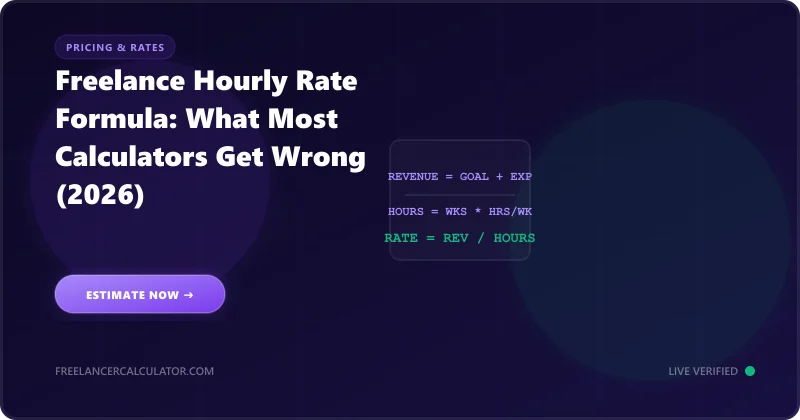
Hourly rate formula mistakes cost freelancers thousands every year. Most calculators divide a salary target by 2,080 hours and ignore self-employment tax, real billable hours, and business expenses. This guide shows you the correct hourly rate formula, step by step, so you can price your work with confidence.
The freelance hourly rate formula is: (Target Income + Expenses + Taxes) ÷ Real Billable Hours
Most freelancers count 2,080 working hours per year — the actual billable number is 800—1,200
Self-employment tax alone adds 15.3% to your cost burden that employees never see
A $80,000 take-home goal requires roughly $168—$180/hr at 20 billable hours/week — not $40/hr
Use the FreelancerCalculator Hourly Rate Simulator to run your real numbers in 60 seconds
The freelance hourly rate formula is: (Target Annual Income + Business Expenses + Taxes) ÷ Annual Billable Hours. Most freelancers never run this calculation correctly — they divide a salary target by 2,080 hours and land on a number that sounds reasonable but quietly destroys their finances. Research consistently shows freelancers underprice themselves by 40—60%. Here’s the math that fixes it, plus a free hourly rate calculator that does it in seconds.
Why “Salary ÷ 2,080” Destroys Freelance Businesses
The naive formula goes like this: *”I want to make $80,000. There are 2,080 working hours in a year. So I’ll charge $38/hr.”* It feels logical. It’s wrong in three expensive ways.
The three costs the naive formula ignores completely:
1. Self-employment tax. Employees pay 7.65% in FICA (Social Security + Medicare). Their employer pays the other 7.65%. As a freelancer, you pay both sides — 15.3% on 92.35% of your net earnings. On an $80,000 income, that’s roughly $11,304 in SE tax before you touch income tax.
2. Real billable hours. 2,080 assumes you bill 40 hours every week for 52 weeks with zero time off, zero admin work, zero business development, and zero unpaid client delays. In practice, freelancers bill 15—30 hours per week. The rest goes to proposals, invoicing, email, accounting, and skill development — none of it invoiced.
3. Business expenses. Software subscriptions, equipment, professional insurance, a home office, an accountant — a typical solo freelancer spends $4,000—$10,000 per year running their business. Employee counterparts pay none of this from their pocket.
The Correct Freelance Hourly Rate Formula (Step-by-Step)
Definition Box
The Freelance Hourly Rate Formula: The minimum amount to charge per billable hour so that after taxes and expenses, you reach your target take-home income.
Formula: (Target Income + Annual Expenses + Tax Liability) ÷ Annual Billable Hours = Hourly Rate
Here’s how to run it yourself:
Step 1: Set your target annual take-home income.
This is what lands in your bank account after all taxes and expenses. Be specific. “$80,000” is better than “as much as possible.”
Step 2: Calculate your annual business expenses.
List every recurring cost: software, hardware, professional liability insurance, accountant fees, phone/internet portion, co-working space, professional development. Most solo freelancers land between $4,000 and $10,000.
Step 3: Estimate your true tax burden.
Add self-employment tax (15.3% of 92.35% of net income) plus your effective federal income tax rate, plus state income tax if applicable. A rough planning figure: set aside 30—35% of gross income for taxes. Use the FreelancerCalculator Tax Withholding tool to get a country-specific estimate.
Step 4: Count your real annual billable hours.
Start with 52 weeks. Subtract 2 weeks vacation, 1 week sick days, and 10 public holidays (roughly 2.5 weeks) — leaves ~47 working weeks. Multiply by your realistic weekly billable hours (not total hours). If you work 40 hours/week but 12 go to admin and business development, you have 28 billable hours/week. That’s 47 × 28 = 1,316 billable hours per year.
Step 5: Run the formula.
| Input | Your Number | Example |
|---|---|---|
| Target take-home income | $ | $80,000 |
| Annual business expenses | $ | $6,000 |
| Tax gross-up (30% of total needed) | $ | $37,143 |
| Total gross revenue needed | $ | $123,143 |
| Annual billable hours | hrs | 1,040 |
| Your minimum hourly rate | $/hr | $118/hr |
The FreelancerCalculator Hourly Rate Simulator runs this calculation instantly with sliders for each variable — no spreadsheet needed.
The Utilization Rate: The Hidden Multiplier Nobody Talks About
Definition Box
Utilization Rate: The percentage of your total working hours that are actually billed to clients. Formula: Billable Hours ÷ Total Working Hours × 100.
Your utilization rate is the single biggest lever on your required hourly rate. Most freelancers have never calculated it.
Typical utilization rates by experience level:
| Experience Level | Utilization Rate | Billable Hrs/Week (40-hr week) |
|---|---|---|
| New freelancer (0—1 year) | 45—55% | 18—22 hrs |
| Growing freelancer (1—3 years) | 60—70% | 24—28 hrs |
| Established freelancer (3—7 years) | 70—80% | 28—32 hrs |
| Expert/specialist (7+ years) | 80—90% | 32—36 hrs |
Here’s what that means for your rate. Two freelancers both want $80,000 take-home and have $6,000 in expenses, with the same tax burden. The only difference is utilization:
| Utilization | Billable Hrs/Year | Required Hourly Rate |
|---|---|---|
| 45% (new freelancer) | 936 | $132/hr |
| 65% (growing) | 1,352 | $91/hr |
| 80% (established) | 1,664 | $74/hr |
The practical takeaway: New freelancers actually need to charge *more* per hour, not less — because they bill fewer hours. The “start low to get clients” advice directly contradicts the math.
To calculate your utilization rate: track every hour worked for one month (billable + non-billable). Divide billable by total. That’s your baseline.
Real Worked Example With Full Numbers
Let’s run the complete freelance hourly rate formula for a mid-level UX designer in the United States in 2026.
Inputs:
- Target take-home: $90,000/year
- Business expenses: $7,200/year (software, insurance, equipment)
- Working weeks: 46 (52 minus vacation, sick days, holidays)
- Billable hours per week: 25 (65% utilization of 38-hr week)
- Annual billable hours: 46 × 25 = 1,150 hours
Tax calculation:
- Gross revenue needed before tax: $90,000 + $7,200 = $97,200 baseline
- SE tax on 92.35% of net: ~$13,752
- Federal income tax (effective ~18%): ~$17,496
- Total tax: ~$31,248
- Total gross revenue needed: $128,448
Result:
- $128,448 ÷ 1,150 hours = $111.69/hr minimum rate
Not $43/hr. Not $60/hr. $112/hr to actually clear $90,000 take-home.
Run your own numbers instantly with the Hourly Rate Calculator — it handles the tax gross-up automatically.
2026 Freelance Rate Benchmarks by Role
Use these as reference points after you calculate your formula-based rate. If your math lands below these ranges, you may need to revisit your income target or expense structure — not lower your rate.
| Discipline | Entry (0—2 yrs) | Mid (3—6 yrs) | Senior (7+ yrs) |
|---|---|---|---|
| Web Developer | $45—65/hr | $75—120/hr | $130—200+/hr |
| UX/UI Designer | $40—60/hr | $70—110/hr | $120—180/hr |
| Copywriter | $35—55/hr | $60—100/hr | $110—175/hr |
| SEO Consultant | $40—65/hr | $75—125/hr | $130—200/hr |
| Brand Designer | $35—60/hr | $65—110/hr | $120—175/hr |
| Social Media Manager | $30—50/hr | $55—85/hr | $90—140/hr |
| Video Editor | $35—55/hr | $60—100/hr | $110—160/hr |
| Business Consultant | $60—100/hr | $110—175/hr | $180—350+/hr |
*Source: Aggregated from Upwork rate data, Contra 2025 Freelance Rates Report, and Glassdoor 2026 data.*
Freelance Rate vs. Corporate Salary: The True Comparison
Before quoting a rate, it’s worth understanding what your rate needs to replace — not just salary, but the full benefits package your employer provides. The Salary Parity Planner calculates this automatically, but here’s the framework:
A $75,000 corporate salary typically includes:
- Health insurance: $6,000—$22,000/year (employer-paid portion)
- 401(k) match: $2,000—$6,000/year
- Paid time off (15—25 days): $4,300—$9,600/year value at $75k salary
- Payroll tax subsidy: $5,738/year (employer’s FICA half)
Total true compensation value: $93,038—$118,338
To *match* a $75,000 corporate job, a freelancer needs to gross roughly $100,000—$120,000 — which at 1,200 billable hours means charging $83—$100/hr.
How to Communicate Your Rate Confidently
The calculation gives you the floor. How you present it matters as much as the number itself. Here are scripts for the three most common rate objections:
Objection: “That’s more than I expected.”
Response: *”The rate accounts for taxes, insurance, equipment, and the time I spend on project management outside our billable sessions. It’s the equivalent of a $[X] salaried role when you factor in what employers cover for their staff.”*
Objection: “Can you do it for less?”
Response: *”I can look at reducing scope to fit a smaller budget — which parts of the project are highest priority for you?”* (Redirect to scope, not rate.)
Objection: “Other freelancers charge less.”
Response: *”You’re right that rates vary significantly. The difference usually comes down to experience, turnaround time, and how much back-and-forth the project needs. What’s your timeline looking like?”*
Frequently Asked Questions
What is the freelance hourly rate formula?
The freelance hourly rate formula is: (Target Annual Income + Business Expenses + Tax Liability) ÷ Annual Billable Hours. It produces the minimum hourly rate needed to reach your take-home income goal after covering all costs. Most freelancers who skip this formula underprice by 40—60%.
How many billable hours does a freelancer actually work per year?
Most freelancers bill between 800 and 1,400 hours per year, depending on utilization rate. A full-time freelancer working 40 hours/week typically bills 60—75% of that time — roughly 24—30 hours/week. After vacations, sick days, and holidays, total annual billable hours usually land between 1,000 and 1,300.
How much should I set aside for taxes as a freelancer?
A safe starting point is 30—35% of gross income for US freelancers — this covers self-employment tax (15.3%), federal income tax, and most state income taxes. UK freelancers should plan for 25—30% depending on income band and NI class. Use the Tax Withholding Estimator for a precise figure.
What is a utilization rate and why does it matter?
Utilization rate is the percentage of your total working hours that are billable to clients. If you work 40 hours/week and bill 28 of them, your utilization rate is 70%. It matters because a lower utilization rate means you need a higher hourly rate to reach the same annual income — a 45% utilization rate requires roughly 78% more per hour than an 80% utilization rate, all else being equal.
How do I calculate my rate if I’m just starting out?
Start with the formula above using your actual income target, then compare to the benchmarks table for your discipline. If your calculated rate is above market benchmarks for entry-level, you have three choices: lower your income target temporarily, cut business expenses, or accept that your ramp-up period may take 3—6 months. Don’t start below the formula result — that math catches up fast.
Is the freelance hourly rate formula the same for all countries?
The structure is the same — income + expenses + taxes ÷ billable hours — but the tax component changes significantly by country. US freelancers face SE tax; UK freelancers pay Class 4 NI; Serbian freelancers use Model A or B quarterly self-assessment. The Tax Withholding tool handles US and UK calculations, and the Serbia Tax Calculator covers the Balkan model.
The Formula Is the Starting Point
The freelance hourly rate formula gives you a defensible floor — the minimum you can charge and still reach your goals. From there, value-based pricing, specialization, and track record let you go higher.
The math is clear: (Income + Expenses + Taxes) ÷ Billable Hours. Run your numbers in the Hourly Rate Simulator right now, then use the Retainer Planner to convert that hourly rate into predictable monthly income.
Disclaimer: Tax rates and platform fee percentages referenced in this article are estimates based on 2026 published data. Individual tax situations vary significantly based on income level, location, deductions, and filing status. Always verify your specific tax obligations with a licensed tax professional or accountant.
“`json
Sources & References
*This article was researched and written by Sarmad, Freelance Finance Strategist at FreelancerCalculator.com. Last reviewed: July 2026.*
1. IRS Publication 505 — “Tax Withholding and Estimated Tax” (irs.gov): Official source for self-employment tax rates (15.3%), the 92.35% net earnings adjustment, and quarterly estimated payment rules used in the hourly rate formula.
2. Freelancers Union & Upwork — “Freelancing in America 2024” (freelancersunion.org): The largest survey of US freelancer earnings, billing practices, and hours worked. Source for utilization rate data and average billable hours per year figures.
3. Bureau of Labor Statistics — “Employee Benefits Survey” (bls.gov): BLS data on employer-provided benefits costs (health insurance, 401k match, paid leave) used to calculate the benefits loading factor that full-time employees receive but freelancers must self-fund.
4. Upwork — “Freelance Forward Economic Impact Report 2024” (upwork.com): Platform-level earnings data used to validate the hourly rate ranges across skill levels and disciplines.
hourly rate formula
An hourly rate formula only works if every input is honest. Most freelancers guess their billable hours and underestimate taxes, so the hourly rate formula spits out a number that feels safe but quietly loses money. The IRS Publication 505 confirms the 15.3% self-employment tax figure every hourly rate formula must include.
Your utilisation rate is the hidden multiplier inside the hourly rate formula. At 50% utilisation you need double the rate of someone billing 90% of their hours, which is why new freelancers using an hourly rate formula often undercharge. Track one full month of billable versus non-billable time before trusting any hourly rate formula output.
Taxes deserve their own line in the hourly rate formula, not a rough guess. Set aside 30–35% of gross income for US federal and self-employment taxes, then refine the number with our hourly rate calculator, which handles the tax gross-up automatically.
Benchmarks are a sanity check, not a substitute for the hourly rate formula. If your calculated rate lands below market for your role, raise it — the hourly rate formula gives you the floor, and your positioning sets the ceiling.
Revisit the hourly rate formula every six months or after any big cost change. New software subscriptions, higher insurance premiums, or a planned holiday all shift the inputs — a stale hourly rate formula quietly erodes your margin.
Communicating the number matters as much as calculating it. When a client pushes back, explain that your hourly rate formula accounts for taxes, insurance, equipment, and non-billable project time — most clients respect transparent maths.
The Bureau of Labor Statistics benefits survey shows what corporate packages really cost, and it belongs in your thinking alongside the hourly rate formula. Replacing a $75,000 salary means grossing $100,000–$120,000 once benefits and employer tax subsidies disappear.
Value-based pricing can sit on top of the hourly rate formula once the floor is secure. Specialists with scarce skills routinely charge multiples of their formula rate — the hourly rate formula keeps you honest while positioning lifts you higher.
Run your numbers today: plug your income target, expenses, tax rate, and real billable hours into our salary parity planner, then let the hourly rate formula reveal what you must charge. Knowing your floor changes every negotiation.
Ready to optimize your freelance finances?
Calculate your rates, taxes, retainer values, project profitability, and more with our interactive tools designed specifically for independent professionals.